


History of jewelry
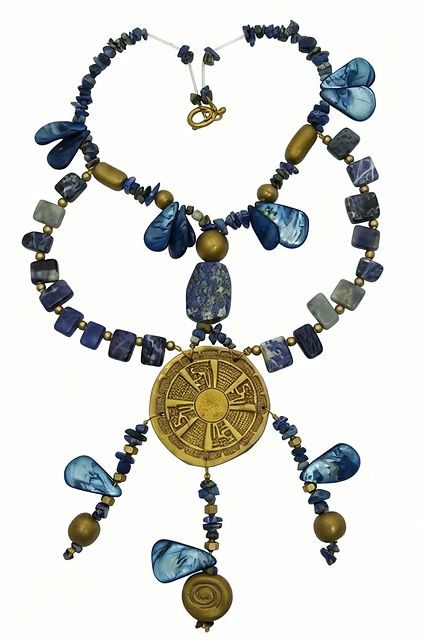
Currently, Designer LILIANA GONZÁLEZ shows off her creativity by combining all kinds of materials to create unique and exclusive designs inspired by the changing rhythm of the universe, manually assembling jewelry that surprises both friends and strangers, which has positioned her as one of the most creative designers and thus undoubtedly marking current fashion.
The history of jewelry is born alongside the history of humankind.
Jewelry has accompanied humans since the dawn of time—created by them and drawn from the earth, it has been used as an ornamental and decorative object, a piece that enhances the physical presence of the human being.
But these pieces carry a message, a meaning. Over time, they have not only fulfilled an ornamental function but have also stood out for their communicative role. They convey messages shaped by their creators, and at the same time, messages born from those who interpret them. Jewelry is full of intention—messages that are transmitted and become part of the emotions and culture of a people.
A piece of jewelry is a small object that can hold great meaning for a person. People and jewelry are inseparable; jewelry exists on a human scale, and people give it meaning. Hierarchy, power, love, protection—jewelry has always been used to communicate with others.
From the beginning, humans have taken different materials and transformed them into adornments to distinguish themselves. Initially, they used bones and teeth from the animals they hunted, and gradually discovered materials in nature that they valued for their beauty and rarity. Since then, a wide variety of materials have been used—even those not considered precious.
Jewelry has evolved over time. The design of pieces has passed through countless trends, redefining shapes, colors, materials, textures, processes, and even concepts. It has changed with fashion, but it has always carried both an ornamental and symbolic function.
The symbolic function gives jewelry its meaning; it allows it to represent different concepts across cultures, to communicate messages that may not be intentionally configured by the designer, but rather emerge from the interpretation of the wearer. The wearer assigns value beyond price or complexity of construction—valuing it for the message it helps convey within their social environment, for what it allows them to represent to others, and for what it means to themselves.
But what allows jewelry to communicate? In its formal configuration, several elements contribute to this communication. Shapes and graphic styles have been studied, but surprisingly, the material itself has rarely been examined—despite the fact that one of the most significant changes in recent years, beyond technological advances, is material innovation.
Today, jewelry walks a path that allows it to be either fine jewelry or costume jewelry. It can feature the most precious and rare metals like gold, silver, and platinum, as well as the most noble and humble materials from nature, such as wood and seeds.
Thus, we see the finest diamonds combined with synthetic acrylic or vulcanized rubber. Barriers are broken, and jewelry stands at the threshold of material innovation, facing the challenge of conveying meaning to society—of containing within its essence a symbolic significance that attracts the consumer and leads them to choose that piece over another.
The influence of materials on the meaning of jewelry.
The material used in a piece of jewelry influences the association of the object with a set of meanings given to it by the members of a given society.
Jewelry is an object created by humans with the intention of adorning their own figure and distinguishing themselves from others—an object that has served as a symbolic manifestation within cultures and societies, whose history emerges alongside that of humankind.
Jewelry has also been used as an amulet or talisman, often analyzed morphologically and associated with magical, religious, and even healing powers. There are documents focused on studying specific types of jewelry—such as rings—that trace their history and analyze changes in materials, forms, and even the meanings these objects have held for humans throughout different eras.
Jewelry is an object composed of both objectivity and subjectivity. Beyond its technical structure, a cultural framework emerges. The object is imbued with meaning—a meaning that arises from the interaction between humans and the object, and from the human relationships that result from that interaction.
Based on this, we can say that jewelry is a sign that emits a connoted message. In advertising, as in the object itself, the message is shaped by the observer or user—it is the meaning they assign to that image or product.
Jewelry, whether cherished or unfamiliar, adopted or imposed, is always individualized. Through its handling and interpretation, a personal mode is exercised—a unique experience, a particular life story. Within it, our perception recognizes the reflection of shared beliefs within the communities we belong to, as well as our own biography.
The designer plays the role of specialist in formulating the language of the product. The professional’s involvement in the development of the piece can range from peripheral to dominant, depending on the sector and nature of the commission.
u
Throughout history, various metals have been used in jewelry—iron, copper, bronze, gold, silver, and platinum—all valued for their beauty and physical properties that allow them to be shaped with relative ease.
Precious stones have been linked to various beliefs and myths. The most well-known is their association with zodiac signs and a series of powers, which has turned them into amulets. It is believed that these stones channel energies—positive or negative—and thus have been given different connotations, many of which are tied to their color.
These attributes are popularly conceived. Stones are considered to have healing properties—both physical and emotional. For this reason, movements like New Age promote therapies using stones and crystals, recommending that each person carry a gemstone to protect them and deflect “negative external energies,” while also balancing internal ones.
In this way, the deep-rooted presence of precious stones in the collective imagination is evident throughout time.
Jewelry-making has involved a wide range of materials over the centuries. In fact, its origins did not lie in metals or precious stones, but in more common materials such as animal bones and teeth, shells, and even earth—which, once fired, became the ceramics and porcelain we know today.
All these materials were chosen by humans because they were attributed with symbolic meanings or valued for specific characteristics. That is why, in what follows, we explore the symbolic content of some of the many materials that have shaped this legendary art form.
Collection of pre-Hispanic jewelry made by Liliana González
The world's first and only pre-Hispanic-inspired collection, crafted from clay with modern, gold-plated finishes.


